
Actually-existing UATX
closer to the "practical liberal arts" vision

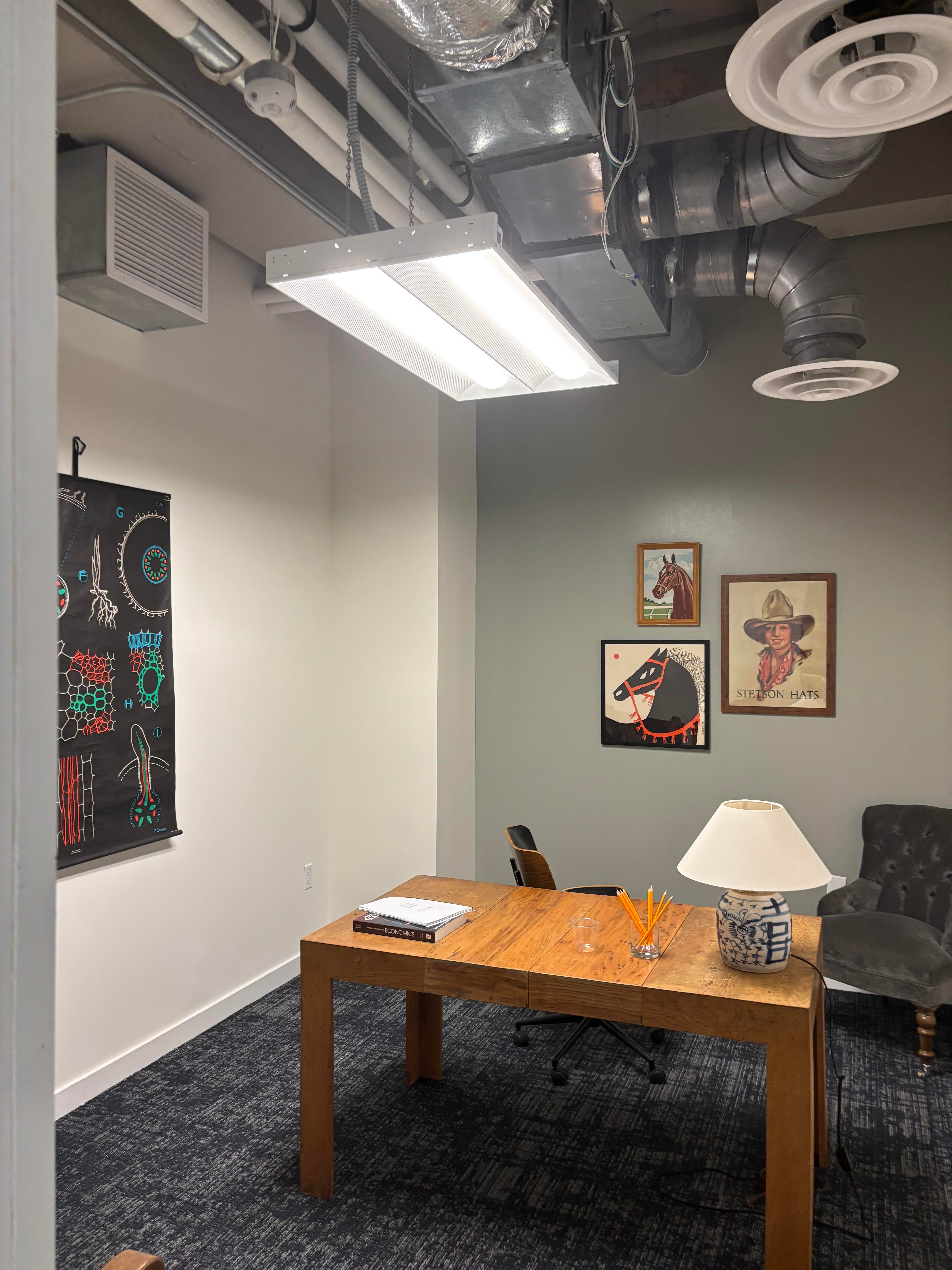
My office. I provided none of the decor.
Now that I have landed at UATX, I think that the external perception that I discussed previously seems off. The students are not right-wing apparatchiks in training. Those who I have talked to rave about the internships they had with local tech companies—as freshmen!
I would describe them as earnest, hard-working, and nice. Way nicer than I was at their age. They like to take initiative. If you have that sort of child, this would be the school to send them.
I credit the current leadership for setting the school on a course that seems to me more positive than the way things looked a couple of years ago. I gather that it has been a bumpy road. I imagine that the challenge in founding an educational institution is to try to be nimble and at the same time introduce some stability.
Several students are frustrated with by what they see as a lack of continuity, even on a day-to-day basis. Their description of the lack of coordination and frequent changes of plans reminds me of Freddie Mac around 1988, before it had a COO. I saw a minor example of this when I walked into my office yesterday afternoon and found a new faculty member working at my desk. He had been told that this was where he was to hold his office hours. He was very apologetic, even though it was not his fault. I have heard other stories that sound to me like snafus that arise when a can-do spirit operates in a setting in which one hand does not know what the other is doing.,
My experience at Freddie Mac was that up to a point the lack of bureaucracy and formal rules feels very empowering to individual professionals. They love it—until they don’t. It ends up not being empowering, because people start getting in one another’s way, initiatives die for lack of follow-through, and too many avoidable mistakes get made.
When you try to bring order to the chaos, there is bound to be turnover among professionals. Some are just unable to accept the need for more structure and better controls.
The trick is to introduce more formal communication without introducing rigid rules and turf protection. And to do that while trying to stay nimble.
My teaching
I think I should try to adjust my teaching approach. My natural inclination is to be improvisational, but the last thing these students need is another dose of unpredictability. To the extent that it is possible, I should try to provide them with a road map. It would be good if I could make a plan and stick to it. But at the same time, I am teaching courses without precedent and trying to boldly experiment with AI.
So far, here are my uses for AI.
giving a vibe-coding assignment for my Public Choice students. They make it sound like they already have more software development skills than I was expecting. If so, then the results should be interesting.
pointing them to relevant sections of my own vibe-coded virtual seminar.
suggesting that they process books and essays by doing “vibe-reading.” What I mean by that is having conversations with AI’s about the materials without plowing through the original sources. Vibe-reading as I conceive it only starts with asking an AI for a summary. It is a more intricate back-and-forth process. But obviously there is no precedent for this approach, so the students and I will be making it up as we go.
I’m also thinking of implementing “vibe-tutoring.” My standards for writing are higher than what I think even the best high school graduates have dealt with. The good news is that their writing is authentic. What I have done a couple of times is paste a student paper into Claude, and then I give Claude the issues I see with the paper. Claude then rewrote the paper. I forwarded the conversation to the student. The student then sees what I thought needed improvement, and also sees what the result would look like. But going forward I am inclined toward a different approach. I plan to tell the students to write a first draft, then feed it to an AI along with a prompt that I supply that has my personal writing do’s-and-don’ts. The prompt1 would ask the AI to explain what ought to be changed and why, but leave it to the student to do the re-write.
Overall
I hope that UATX manages to get its external reputation more aligned with its current approach as I see it. I would like to see more stories about the talent network (which is fully functioning, not some empty brochure) and fewer stories about Forbidden Courses.
As of now, I would be inclined to strongly recommend UATX for qualified students. I think that actually-existing UATX is providing them with a good experience.
Writing Style Feedback Prompt
Paste your paper below this prompt. I will review it for style, grammar, and syntax according to the following preferences:
Style Requirements
Journalistic style: direct, clear, factual
Short sentences and short paragraphs (no hard length limits, but favor brevity)
Concise - eliminate unnecessary words
Avoid repeating the same word within a paragraph
Use concrete examples to clarify points
Avoid stream-of-consciousness or rambling prose
Formal but not conversational
Additional Guidelines
Passive voice is acceptable
Jargon is acceptable only when used correctly
I will suggest where examples would strengthen your argument
If your paper has many issues, I will focus detailed feedback on the first few pages, then ask you to revise before I continue with later sections
Format of Feedback
Provide a two-column table:
Left column: problematic phrase or sentence from your paper
Right column: specific criticism and suggested revision
Focus on the most significant issues first.
[PASTE YOUR PAPER HERE]
As a bewildered, retired-for-four-years ex-corporate R&D scientist/engineer and Berkeley Ph.D. holder ('84) I cannot tell you how great this sounds. You seem completely aware - and at ease - with the hard FACT that it is unlikely anyone will look back at your present adventure in some years and say "This is when we started doing things exactly the way we do them now". Rather, that you are embarking on figuring out how to do things better, in ways that will doubtless change and change and change again as we continue to figure it out. "Bravo!" to you, Professor!
> The trick is to introduce more formal communication without introducing rigid rules and turf protection. And to do that while trying to stay nimble.
If you can model this for your students, then you'll make a huge difference in their lives.
> So far, here are my uses for AI.
My guess is that 25-75% of our work is going to be finding ways to test and manage the AIs. So developing rubrics, prompts or applications to test the outputs designed by other students might be valuable.