
The Nixon Era
compare with the Trump era

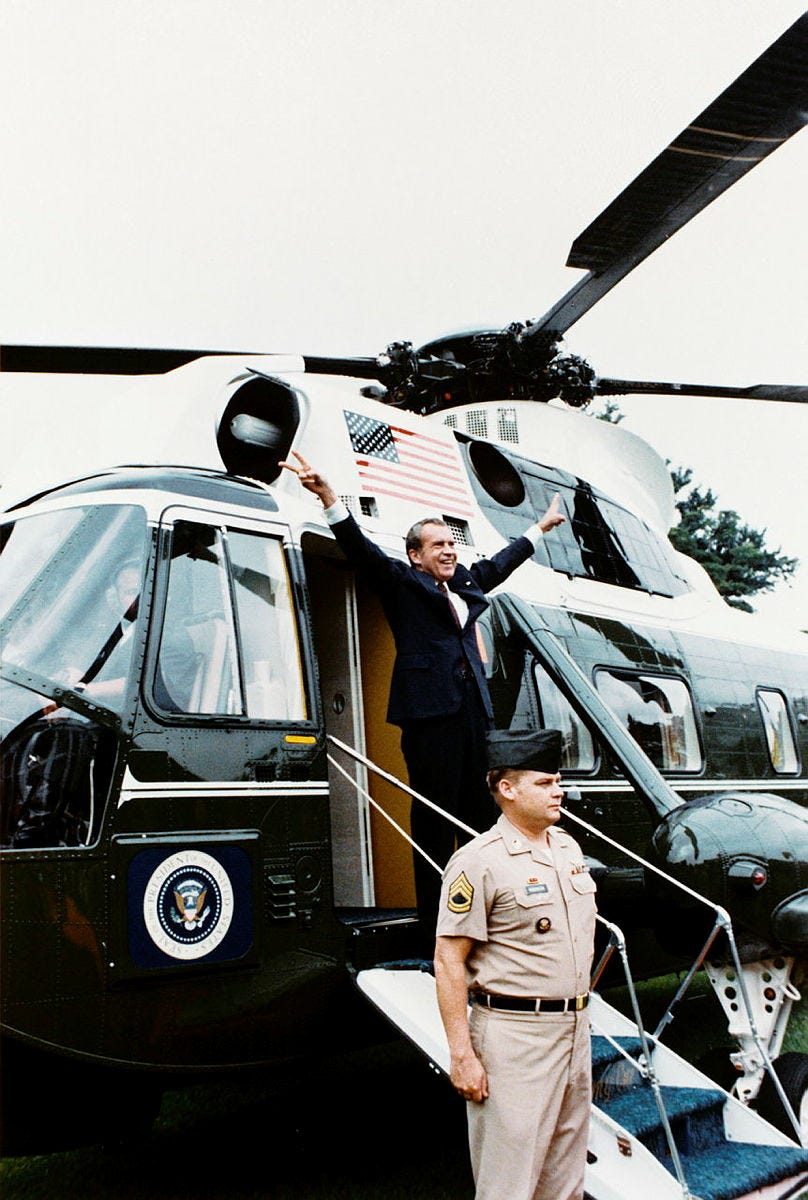
When I start my teaching gig at UATX in a little over a month, the age gap with my students will be over 50 years. "When I was your age…” might turn out to be my most-often used phrase.
When I was their age, Richard Nixon was President. His election in 1968 would never have been predicted in 1964.
In 1964, the Democrats won a landslide victory under President Johnson. Pundits were writing the political obituary for Nixon individually (he was not a candidate in 1964, having lost the California governor’s race in 1962) and for the Republican Party collectively.
But 1968 was a year of backlash. Middle America reacted against hippies, anti-American anti-war activism, and black street riots with a vote of “No. Give us Nixon.”
In the 1972 Presidential election, the Democrats nominated George McGovern, an implausible candidate who appealed only to the party’s left-wing base. The result was a punishing defeat. But the Democrats never lost control of Congress (Joe Biden was elected to the Senate that year). And they loathed Nixon as much as they loathe Mr. Trump today.
The Democrats staged a huge comeback in 1974. Nixon was forced to resign because of the Watergate scandal.1 In hindsight, the scandal seems tame in comparison to what we have seen more recently. But so far the attempts to use the Watergate playbook against Mr. Trump have failed. Some possible reasons:
something like that is effective the first time, but not so much subsequently
alternative media did not exist then, but they do now
Mr. Trump is more combative than Mr. Nixon
the Republican Party is more loyal to Mr. Trump than it was to Mr. Nixon
In the midterm elections that followed, the Democrats picked up almost 50 seats in the House and gained 4 Senate seats, bringing their majority to 60. They promptly changed the rule for ending a filibuster rule to require only 60 votes, rather than the 67 needed previously.
If the parallel with the Nixon era holds, Democrats will win both houses of Congress in 2026. They will then end the filibuster altogether.
The Democratic Congress appropriated large sums of money for programs that Nixon did not like. He tried to undo these appropriations by “impounding” the funds, meaning not spending them. Congress responded by passing the “impoundment control act,” which included establishing the Congressional Budget Office as an institutional counterweight to the President’s Office of Management and Budget.
Nixon’s effort to control spending through “impoundment” was thwarted. Thus, when President Trump and DOGE made similar attempts to rein in spending, they were been stymied by the courts.
Both Mr. Nixon and Mr. Trump pulled off foreign policy upsets. Nixon (and his secretary of state Kissinger) produced a peace treaty in Vietnam. And he opened up relations with China. Mr. Trump produced a peace treaty for Gaza. And he pressured Europe into raising defense spending.
Both Mr. Nixon and Mr. Trump adopted economic policies that confounded free-market advocates. Mr. Nixon tried to fight inflation with wage and price controls. Mr. Trump tried to promote domestic industry using tariffs.
Voters do not like inflation. In 1976, President Ford, Nixon’s successor, was mocked for his ineffectual “Whip Inflation Now” slogan, printed on buttons. Jimmy Carter, who defeated Ford, saw inflation soar even higher, so that he was trounced in 1980 by Ronald Reagan. My guess is that as long as deficits remain as high as they are, inflation will persist, and the electoral consequences will be adverse for whichever party is in power.
In short, although much has changed over the last 50 years, there are a number of parallels between the Nixon era and the Trump era that may be instructive.
Random note. The movie “All the President’s Men” opens with security guard Frank Wills seeing tape on the door of the basement of the Watergate Building. When I saw the movie, I recognized the door, because when I was a research assistant in DC, the Federal Reserve had an annex in the building, and I walked through that door before ascending to the auxiliary offices.
A striking difference between that two periods (Nixon v. Trump) is the culture wars. While the Democrats had a different set of spending and foreign policy priorities under Nixon, the cultural differences between mainstream Democrats and mainstream Republicans were trivial compared to the situation today. One reason Trump’s supporters are loyal to him is that they believe Democrats would destroy what little remains of traditional American values or her institutions.
> Jimmy Carter, who defeated Ford, saw inflation soar even higher, so that he was trounced in 1980 by Ronald Reagan.
I was taught that Carter appointed Volker to the Fed, he raised rates hard, and the resulting recession helped elect Reagan