
Claude does TLP
It performs amazingly well

A while back, I created a Claude project to build a Socratic tutor for my political psychology course. Recently, I was invited to give a talk on The Three Languages of Politics. I asked Claude to look through the project material and create a slide deck. Claude asked me one question—who is the audience? “Bright and engaged students,” I replied. In one shot, Claude Fable came up with something I was perfectly happy with. Note: the whole deck is 18 slides. I only show a few of them below.
Then I asked Claude to put it into a format for this article. I have not changed a word. It is uncanny the way that Claude captured the key points that I would have made had I tried to do something like this myself.
The Three Languages of Politics — and the Psychology Beneath Them
Adapted from a talk. The slide deck is attached at the end of the post.
Start with a case. On April 29, the Supreme Court ruled 6–3 in Louisiana v. Callais that Louisiana’s second majority-Black congressional district was an unconstitutional racial gerrymander, effectively gutting Section 2 of the Voting Rights Act. The vote split along ideological lines.
I am not going to ask who was right. I am going to ask a different question: how would you expect a progressive, a conservative, and a libertarian each to react?
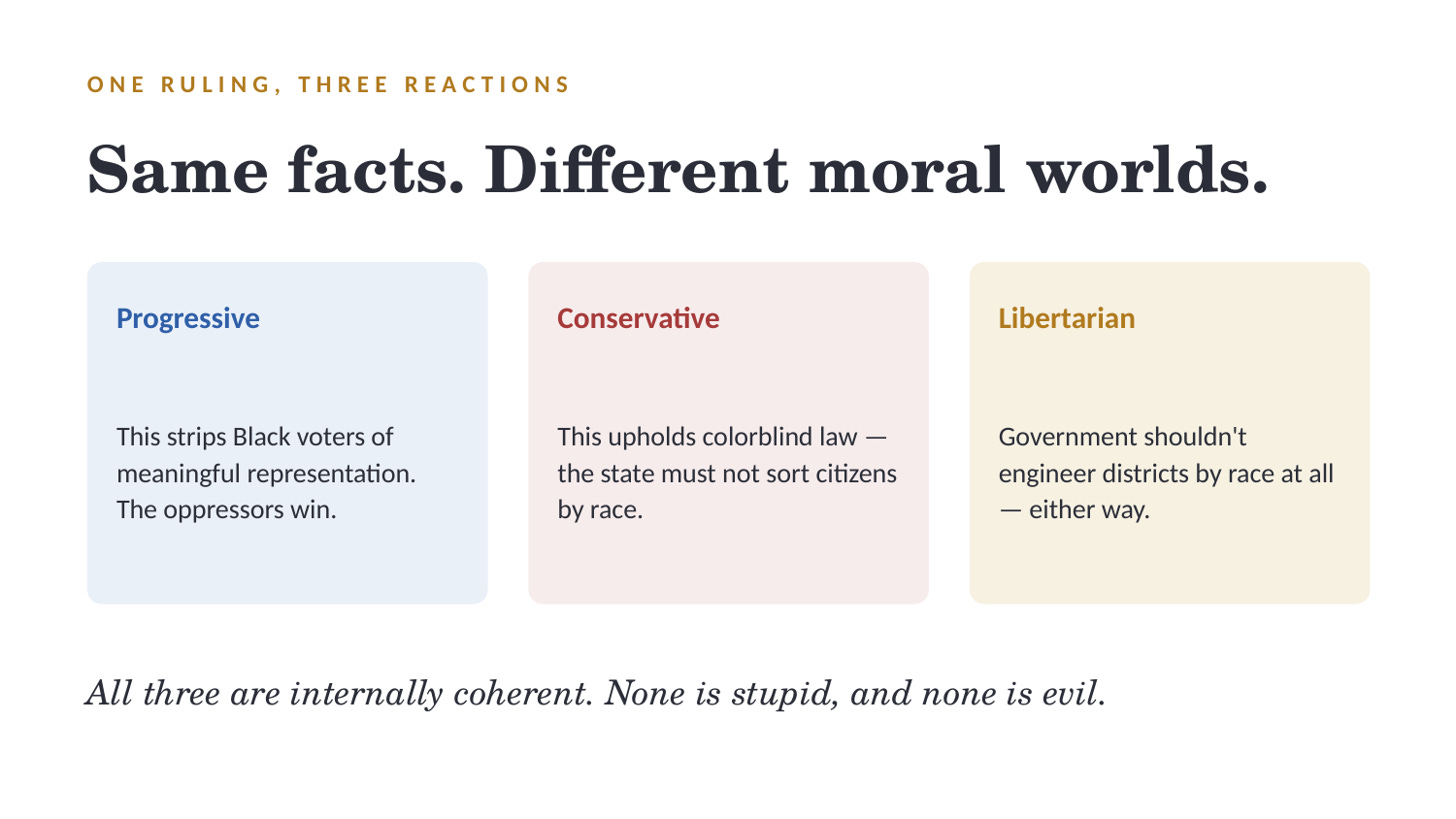
The progressive says: this strips Black voters of meaningful representation. The Voting Rights Act was a hard-won protection for a marginalized group, and the ruling empowers the oppressors.
The conservative says: this upholds colorblind law. Race-conscious districting is itself racial classification, and the state must not sort citizens by race.
The libertarian says: government should not be engineering districts by race at all — the original gerrymander and the VRA-mandated remedy are both examples of the state sorting people by race, which is the problem, not the solution.
Notice that all three reactions are internally coherent. None of them is stupid, and none of them is evil. They are not even contradicting each other the way factual disagreements do. They are framing the same event in different moral vocabularies.
That is the phenomenon my Three Languages of Politics tries to describe.
The model
The claim is that when politically engaged Americans communicate about political issues, they tend to fall back on one of three axes — and the axis someone reaches for is a reliable signal of political tribe.
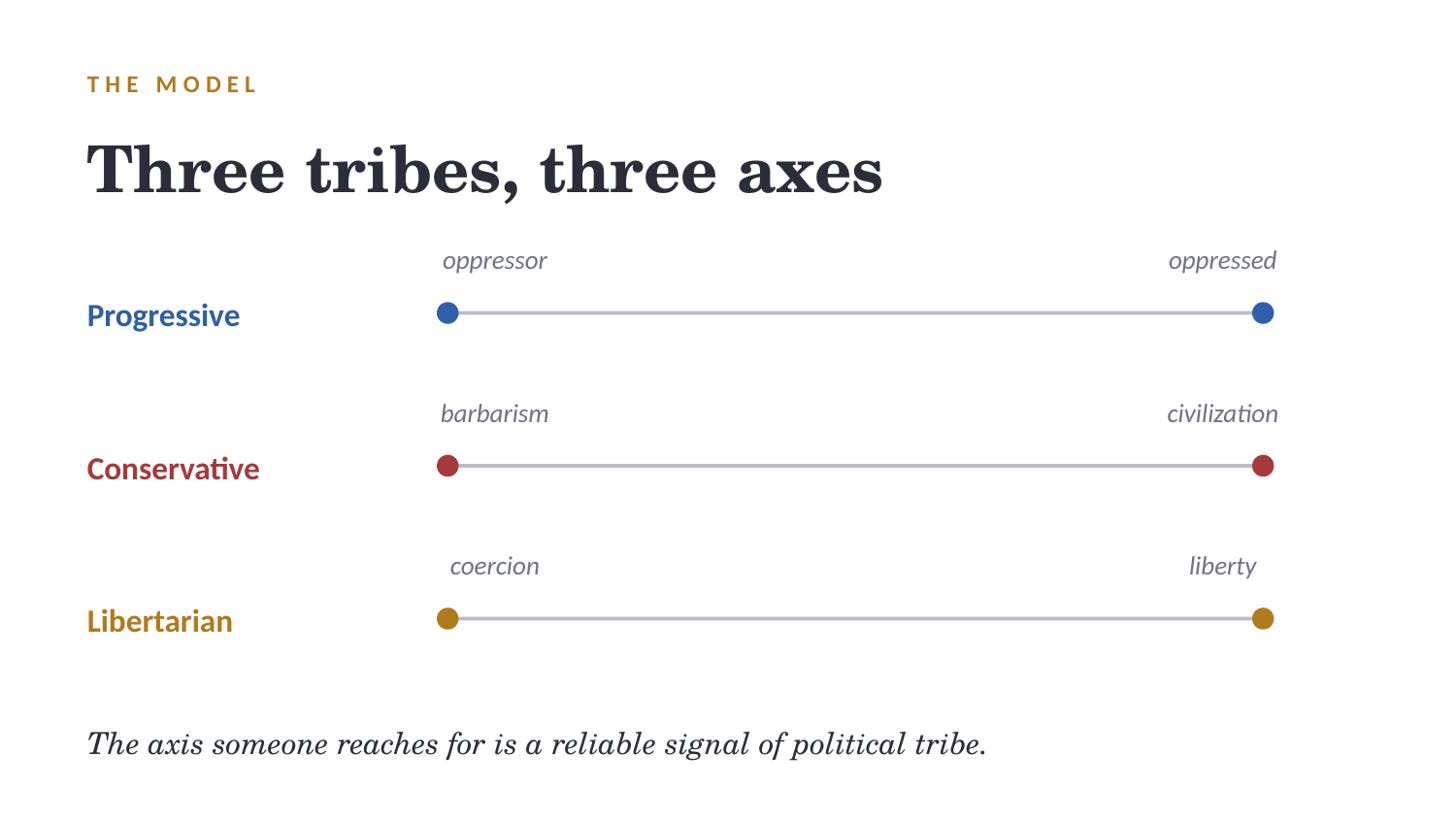
Progressives communicate along the oppressor–oppressed axis. The fundamental question: who is being victimized, and by whom? Conservatives communicate along the civilization–barbarism axis: what threatens the institutions and norms that make civilized life possible? Libertarians communicate along the liberty–coercion axis: where is the state expanding its power over individuals?
Two disclaimers, both easy to miss, both important. The model is not a theory of ideology — it does not explain why anyone becomes progressive, conservative, or libertarian, and each of those traditions is deeper than its slogan. And it is not a map of moral reasoning. The axes are not how people arrive at their conclusions. They are the language people reach for when talking about conclusions already reached.
That gap — between reasoning and language — is where the interesting psychology lives.
Here is the observation that unlocks it: everyone opposes the bad thing. No one is for oppression. No one is for barbarism. No one is for coercion. These are not competing values; they are universally shared negative values. What differs is which threat each tribe organizes its identity around — and which one it accuses the other tribes of enabling. Conservatives accuse the others of being soft on barbarism. Progressives accuse the others of defending oppression. Libertarians accuse both of expanding coercion. The three languages are less three sets of values than three axes of demonization.
Why do we talk this way?
The model describes a pattern. It does not explain it. For that, you have to go back a long way before the Voting Rights Act.
Politics precedes language. Frans de Waal’s chimpanzees build alliances, trade favors, betray partners, and reconcile — without a word. Alpha status in a chimp colony is won by coalition management, not raw strength; a strong chimp with poor alliances loses to a weaker chimp with better ones. Political instincts are products of evolution, not culture.
And our minds bear the marks. Leda Cosmides and John Tooby showed that people fail an abstract logic puzzle that they solve instantly when the identical puzzle is framed as catching a cheater. The mind is not a general-purpose reasoner. It runs specialized modules — cheater detection, us-versus-them, loyalty tracking — built for life in coalitions.
Jonathan Haidt supplies the next piece: intuition first, reasoning second. His metaphor is a rider on an elephant. The elephant — our automatic moral intuition — moves first. The rider — conscious reasoning — mostly writes the elephant’s press releases. We experience ourselves as reasoning toward moral conclusions; mostly we are rationalizing conclusions already reached.
Kurt Gray and Daniel Wegner add the template those intuitions run on. Every moral story casts two roles: a suffering victim and an intentional villain.
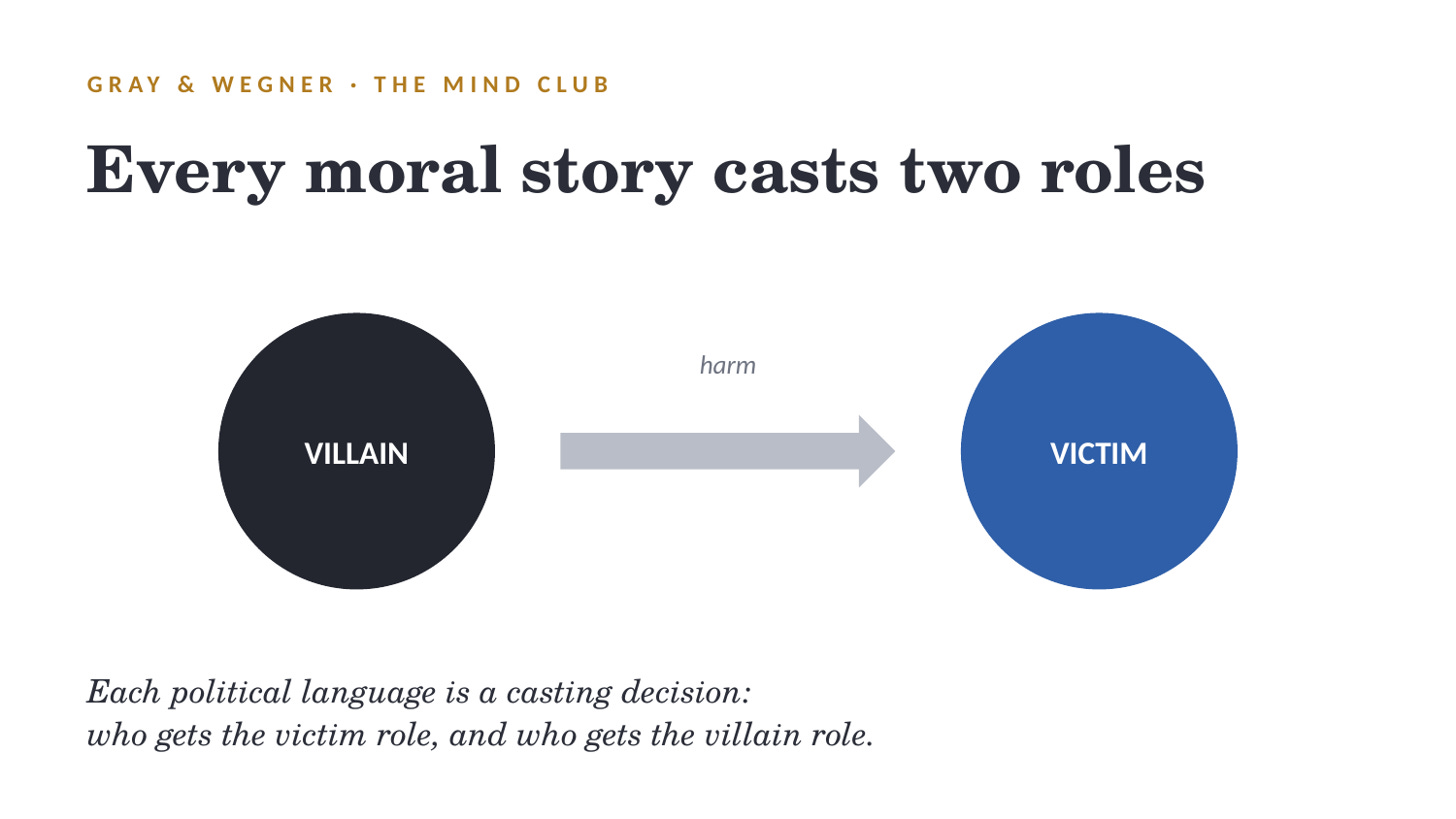
Each political language is a standing casting decision. Progressives cast the marginalized as victim and the powerful as villain. Conservatives cast civilization as victim and disorder as villain. Libertarians cast the individual as victim and the state as villain. Look at how progressives and conservatives frame Gaza: near mirror images, the same events with the victim and villain roles swapped.
Dan Williams completes the picture with an economic insight. You cannot believe just anything — beliefs need justifications you find genuine. But the belief usually comes first, from tribe, intuition, or emotion; the justification is hired afterward. And when millions of people need the same justifications, that demand creates a market. Political media does not sell information. It sells justification. This is why counterargument bounces off: you are not engaging a reasoned conclusion, you are engaging the rationalization of a tribal commitment. Refute one rationalization and you merely trigger a search for a better one.
The darkest product in that market is what David McRaney calls the illusion of asymmetric insight: the conviction that you understand your opponents better than they understand themselves. The progressive knows that colorblindness is really cover for preserving hierarchy. The conservative knows that climate policy is really cover for controlling people. The libertarian knows that everyone else’s compassion is really a lust for power. Asymmetric insight ends dialogue before it starts, because it declares the other side’s stated reasons not worth engaging.
Put it together and the conclusion is uncomfortable. The three languages are not reasoning. They are signaling. Speaking your tribe’s axis is good for three things: reassuring others of your loyalty, raising your status among those who agree, and whipping up hostility against the other tribes. What it is not good for is persuading anyone outside the tribe. Most political commentary does not open minds on the other side. It closes minds on its own side.
Does the model need a fourth axis?
I have come to think the three languages may not fully capture the current moment. The civilization–barbarism axis describes a conservatism with intellectual roots — Burke, Kirk, ordered liberty. Much of Trump-era politics is animated by something else: hostility to a credentialed elite seen as having captured the institutions.
Borrowing from Alana Newhouse, I call this the brokenism axis. It is not a replacement for left–right; it is a second dimension that cuts across it.
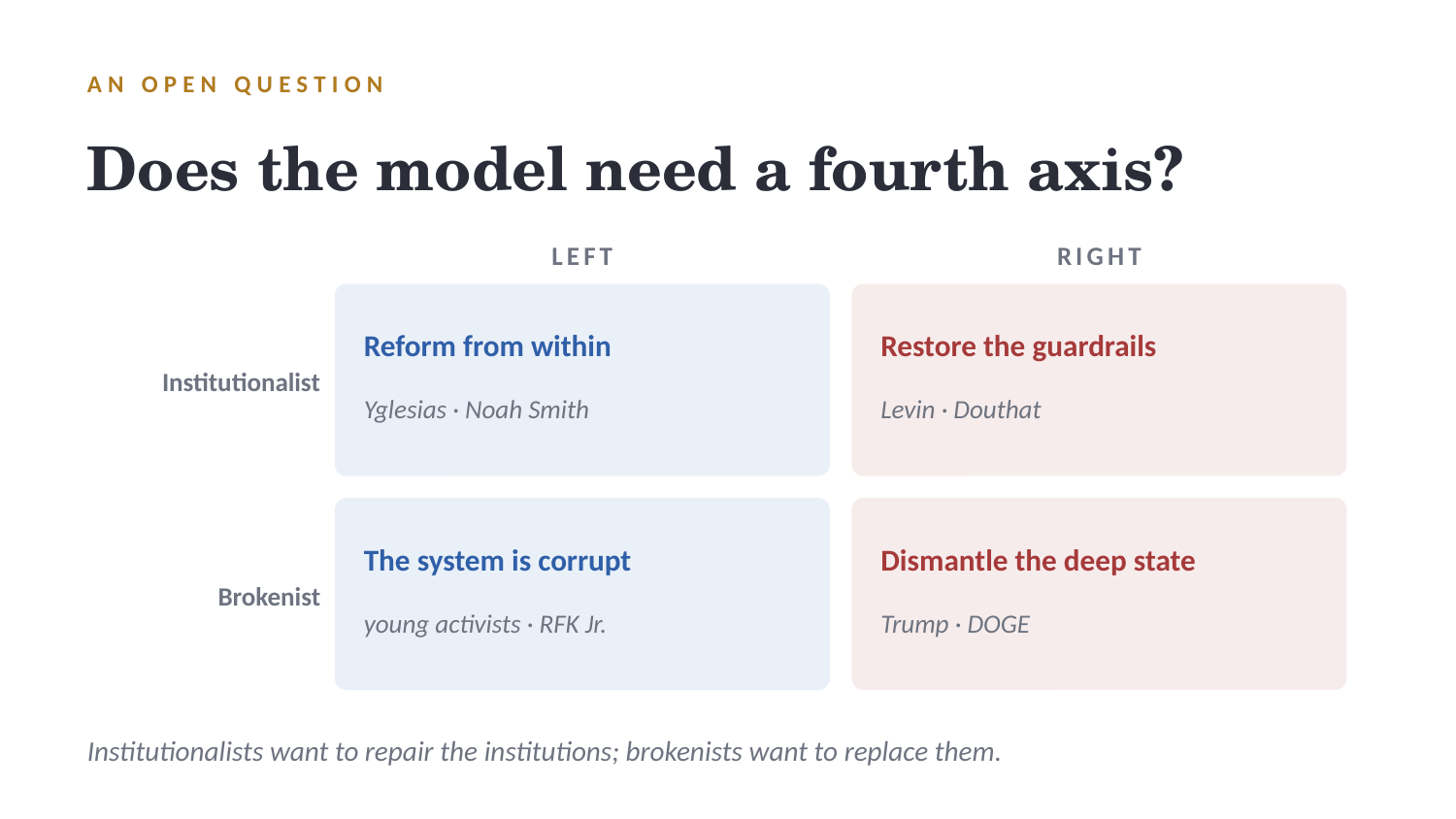
Left-institutionalists want to reform the system from within. Right-institutionalists want to restore the constitutional guardrails. Left-brokenists think the system is corrupt root and branch. Right-brokenists want to dismantle the deep state. Institutionalists want to repair the institutions; brokenists want to replace them. Whether this is a fourth language, a cross-cutting dimension, or just civilization–barbarism turned against domestic institutions is a question I regard as genuinely open.
What to do about it
The three languages are tools of fast political thinking — ready-made frames that settle questions without engaging their complexity. The prescription is to slow down.
Notice your default axis; most of us reach for the same language automatically. Learn the other two — not to convert, but to see how the issue looks from there. Try to pass the Ideological Turing Test: state the opposing view so that its actual holders would say, yes, that is our position. And when you catch yourself thinking “I know their real motives,” treat that as a warning sign, not an insight.
One last problem. If asymmetric insight is real, then I understand progressives and conservatives less well than I think I do. That applies to everything you have just read. Bear it in mind when you consume political commentary — including mine.
An open-minded libertarian on campus, thoroughly immersed among progressives, might willy nilly become competent at the ideological Turing Test for Ph.Ds.
But few on campus will pass the ideological Turing Test for any stripe of populism.
Really really good, better than great. (Like?) Arnold at his best: insightful, important, clear, brief.
Particularly important is how every axis has the victim & the villain, and all are against the villains of each axis.
Plus open to the possible new brokenist axis.